

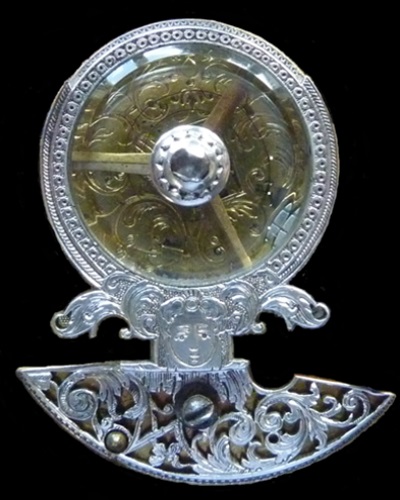
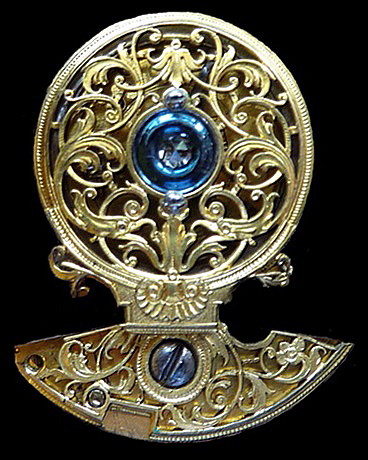
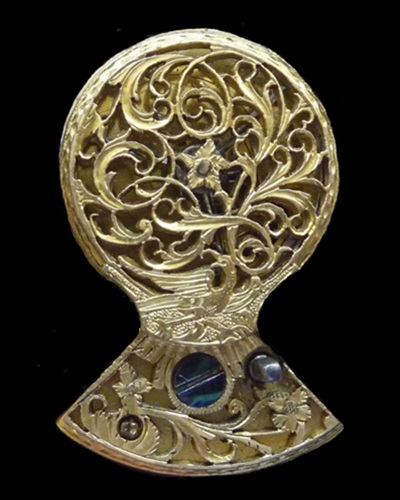
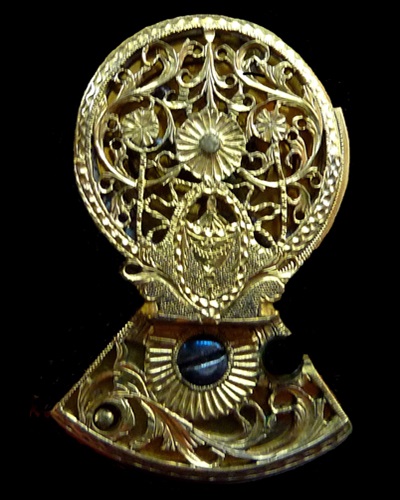
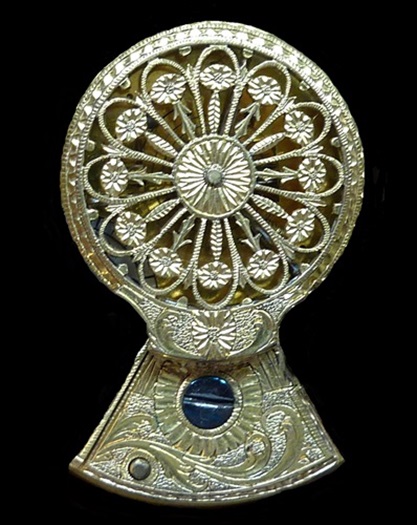
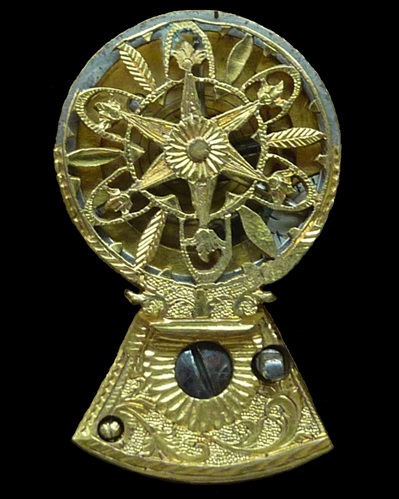
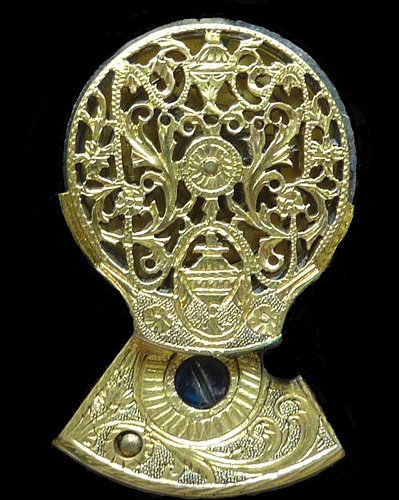
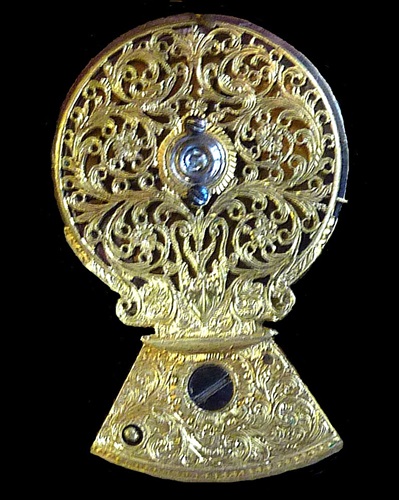
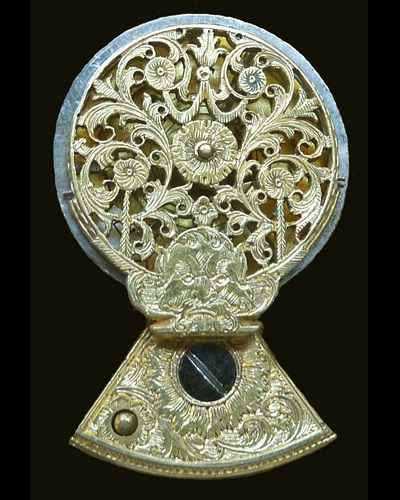
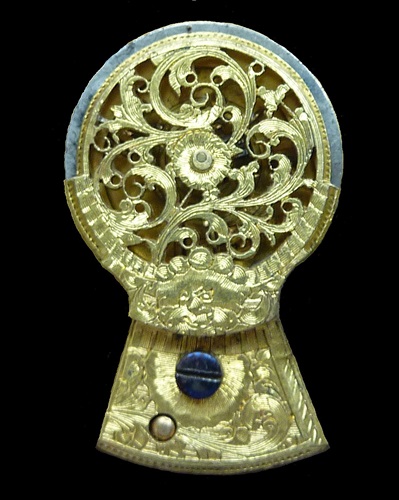
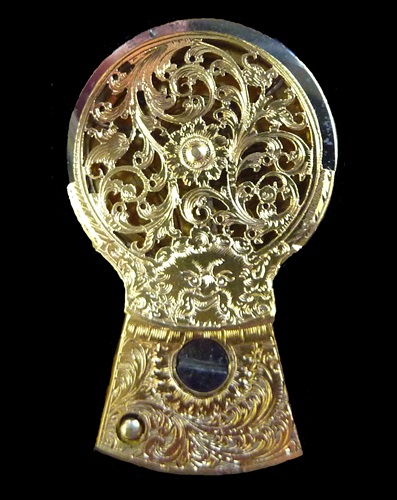
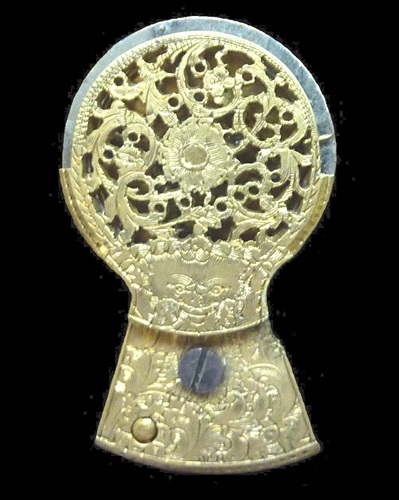
TOP ROW c.1720 TO c.1790
James Markwick, London
Richard Gregg, London
William Pretty, London
E.Parkinson, London
SECOND ROW c.1790 TO c.1840
Abraham Hunt, Yarmouth
William Bateson, London
Maker unknown
Vale & Co., Coventry
THIRD ROW c.1850 TO c.1875
Robert Hartley, Bury
William Windle, Stockton
Towers, Wincanton
Maker unknown
BOTTOM ROW c.1875 TO c.1895
Maker unknown
Kay, Worcester
Marks, Hertford
Maker unknown
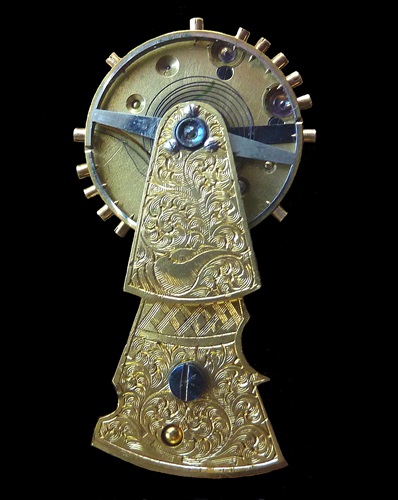
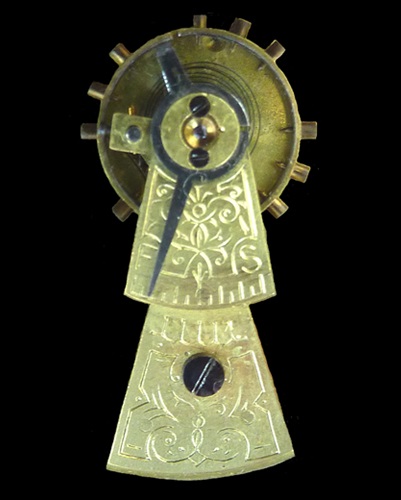
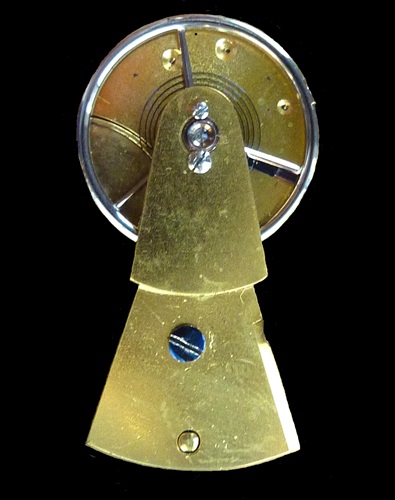
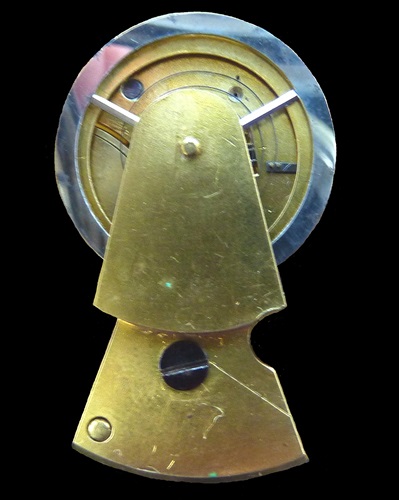
In 18th and 19th century English pocket watches the delicate balance wheel, with its back and forth rotation, was supported and protected by components known as a watch-cocks. By examining examples of these through time we get a picture of both change and continuities.
Despite being part of the inner workings of the watch, not visible unless the case (often a double case until the mid to late 19th century) was opened, watch-cocks were frequently highly decorated. In general they were made of pierced and engraved, or more deeply carved, brass, though rare examples such as that by Markwick (top row, far left) show that other materials (in that instance silver, rock crystal and diamond) could be used.
In the period from the early 18th century to the end on the 19th, there appears to have been a process of simplification and reduction. By the late 18th century the foot, by which the watch-cock was attached to the rest of the movement, had begun to narrow, and soon the decoration of this section was no longer pierced through. The examples shown here suggest that by the mid-19 th century there was a reduction in the degree of hand-working, with shallower engraving replacing deeper carving, and round drill-holes becoming more obvious in the piercing of the upper circular section. Later in the century, as the mechanisms of pocket watches went through greater transformations, there were further changes in shape and reduction in size. The upper section was not pierced and no longer covered the whole of the balance wheel.
Looking at the first and last examples shown, it is clear that we have gone from a minor work of art to something treated as a purely functional mechanical component. This could be said to reflect the movement from a fully hand-crafted object of relative luxury to the more mechanical production of something with a wider ownership. While there may be truth in this, there are caveats. For instance some of the very finest and most technically innovative watch movements of the early 19th century are relatively undecorated, while in other cases the extent and quality of decoration may show the skill levels of the craftspeople involved, as well as the variations in effort and time to be invested in producing a products of differing quality and price. Even some of the earlier examples here, demonstrate markedly different levels of skill or effort used in turning out similar designs. Whatever the factors involved, the expectations about how the interior of a watch should appear changed markedly from the later 19th into the 20th century.
Perhaps more surprising than this change is how long the urge towards extensive decoration persisted. Particularly in the earlier examples, design elements can be linked to dominant styles of the periods in which they were made. If the piece by Markwick (top row, far left) offers characteristically baroque scrolling foliage and cherubic mask, the somewhat later example by Pretty (top, centre right), with its flowing asymmetricality, reflects the rococo aesthetic. Neo-classical elements, such as the urn seen in the work of Parkinson (top, far right) appear in the latter part of the 18th century. Two-way symmetry in design is found in the “geometric” watch-cocks of the late 18th/early 19th centuries (second row, far left and centre left). Yet, despite such innovations, there are obvious continuities, particularly in the treatment of the leaf scrolls on the foot section.
I would suggest that consistencies of design become even more marked in the middle part of the 19th century, with minimal attempts at innovation and a growing consensus on what constituted the ‘right’ decoration for a watch interior. Even if new styles, and new-old styles such as neo-gothic, were winning out elsewhere, the pocket watch interior remained resolutely baroque in inspiration. The grotesque mask was an element repeated many, many times (all third row). This is found in some watches of the early 18th century, but seems to become more of a fixture over a century later. Possibly by this period the old-style pocket watch was a Victorian icon of ‘vintage’ design. A comforting connector to an earlier age? A reflection of past luxury for the expanding middle-class? Amongst the examples here, it is only with Kay of Worcester (bottom row, centre left) that the much-reduced decoration breaks from convention, with design elements rather closer to those seen elsewhere in late Victorian Britain. Moving into the 20th century the watch interior largely ceased to be an object for aesthetic appreciation or, where it was, this was directed more to the quality of its engineering design than to added decoration.
Horologists and historians of design can, I am sure, refine, amend and enlarge upon this necessarily impressionistic survey. For discussion of some other aspects the topic see Peter Rivière’s account of the collection held by the Pitt Rivers Museum, Oxford, which can be accessed throughthe museum’s website “ENGLAND: THE OTHER WITHIN: Analysing the English Collections of the Pitt Rivers Museum” (Object biographies>Watch cock) or by using the link: Watchcocks donated by Arthur Thomson (ox.ac.uk)