

The abstract forms and fluid lines of the figures in the two prints shown here give them a curiously mid-20th century feel. But their subject matter places them firmly in their true period, the early 19 th century. Their creator, E. Hull (Edward Hull), was a printmaker and publisher who worked at Kennington Oval in London from the later Regency period through the reign of George IV (c.1815-1830).
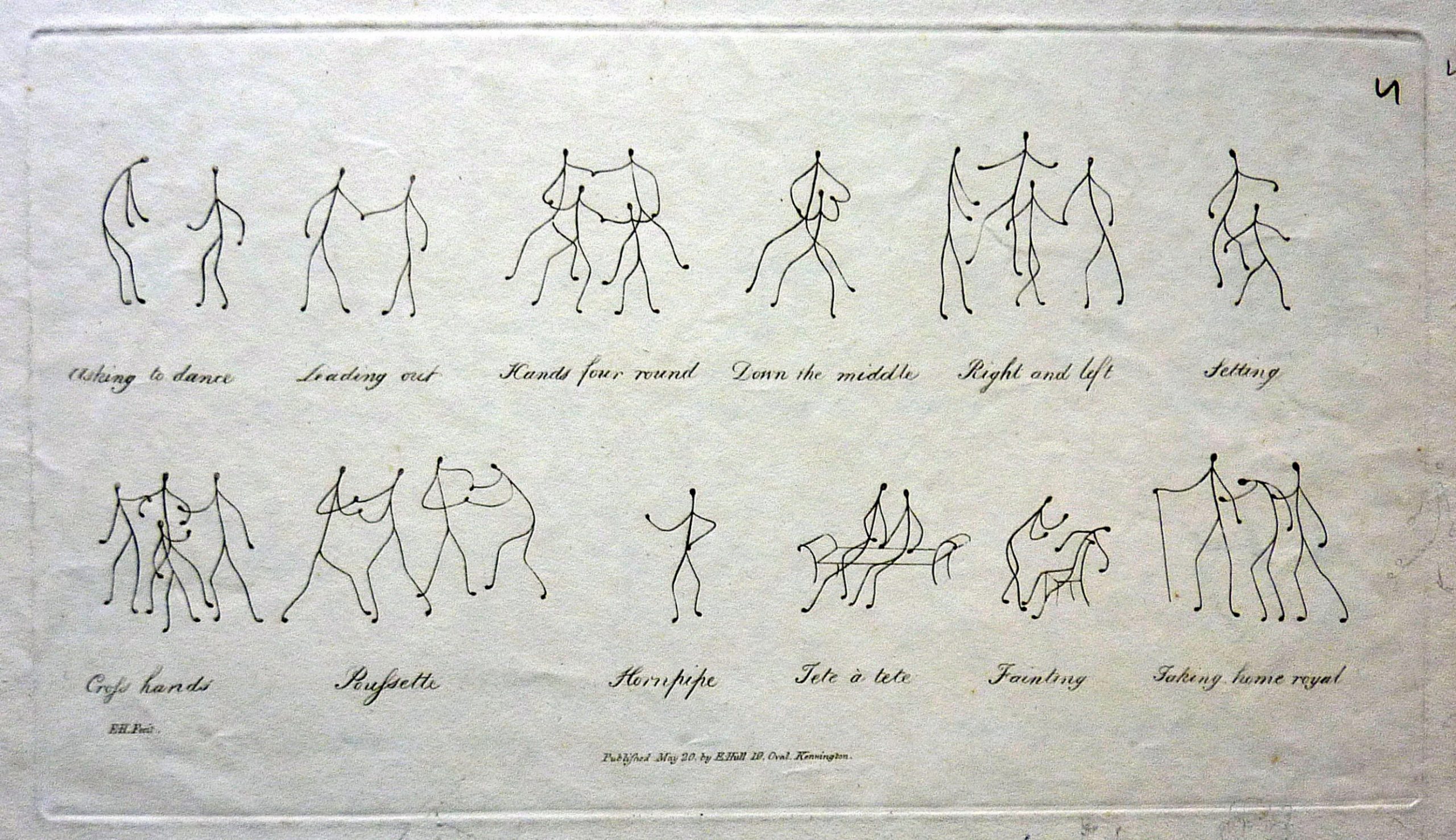
The first sheet represents scenes of a social evening. Central to such an evening was dancing. In early nineteenth century England set dances (quadrilles, country dances, reels, etc.) performed by couples in formations remained predominant, rather than the pair dances which would become a focus of later ballroom dancing. Hull offers us a various moments on the dance floor from the invitation to a partner through specific dance moves – amongst these ‘Setting’ involved dancing on the spot whilst facing a partner, while in the ‘Pousette’ couples exchanged places. The final three sets of figures provide glimpses of events beyond the dance– the opportunity for a more intimate exchange in a Tete a tete on a scroll-ended bench, a fainting fit, and a royally drunk man being helped home by his companions.
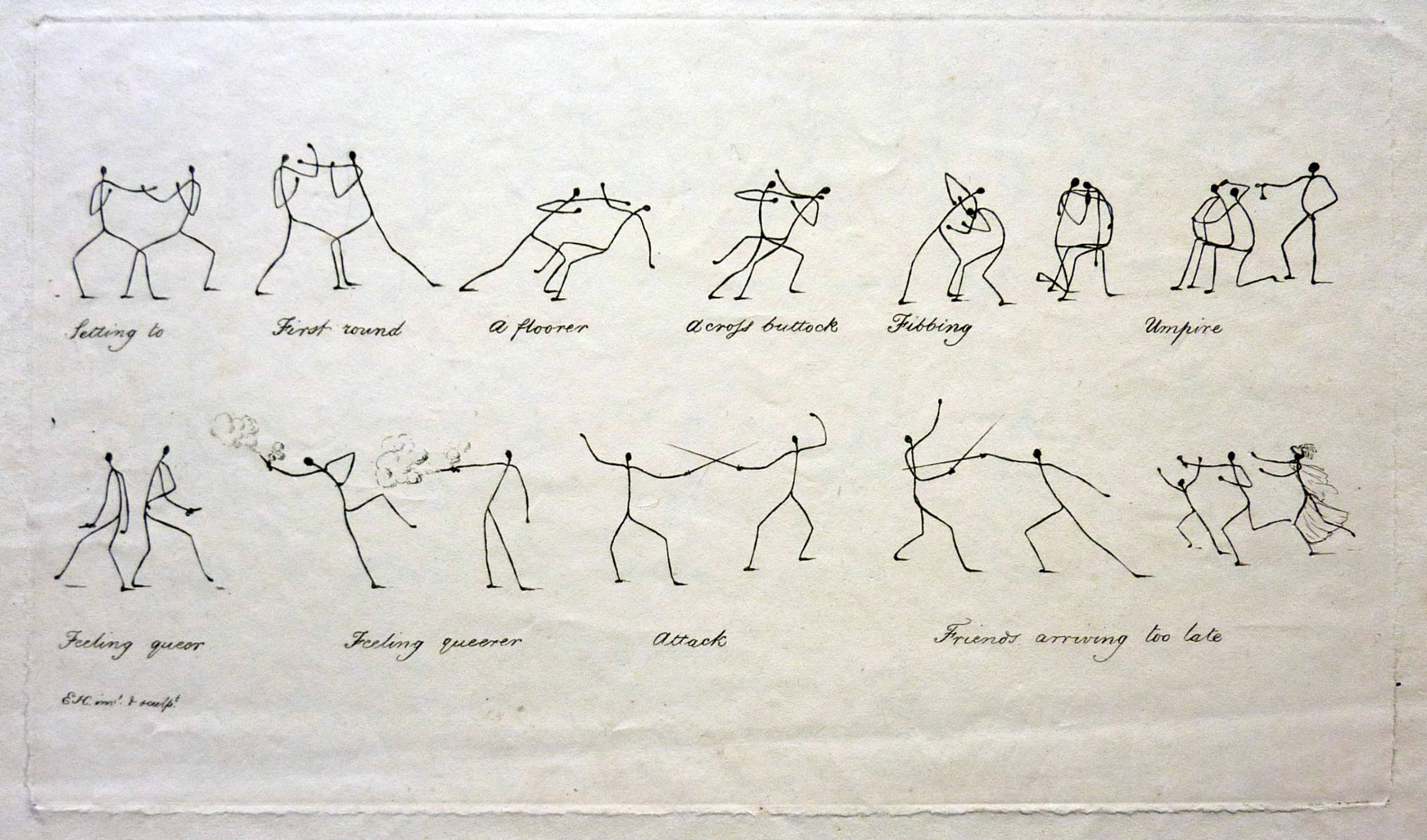
A more violent side of Regency life appears in the second print which shows the worlds of boxing and duelling. Boxing, in particular bare-knuckle prize fighting, had a strong following in the first part of the 19 th century. The journalist/author Pierce Egan published five volumes of his Boxiana: Sketches of Ancient and Modern Pugilism between 1812 and 1828, while prominent prize fighters were selected as ushers and pages at the coronation of King George IV in 1821. Some of the figures in this set offer a reminder that fights of this period involved moves beyond those allowed in the modern boxing ring. A Cross buttock was a form of throw, while Fibbing involved a stream of blows delivered whilst holding the opponent’s head or neck.
Though nominally illegal in Britain, and in decline, honour duelling continued into the nineteenth century (the last fatal duel being fought in the 1852). In the early decades of the century even government ministers engaged in duelling. Famously Viscount Castlereagh, Minister for War, and George Canning, Foreign Secretary, fought a duel in 1809, in which Canning was wounded. As late as 1829, the Duke of Wellington fought a duel, whilst Prime Minister. These were duels using pistols, as shown in the figures Feeling queer and Feeling queerer. By the time the print was produced duelling with swords would have been very rare. It was probably the visual potential of the older practice that led to its inclusion.
There are obvious similarities between the two prints produced by Edward Hull and two published in 1817 by S.W Fores of Piccadilly, London, under the title Striking Effects produced by LINES & DOTS -for the Assistance of young Draftsmen.
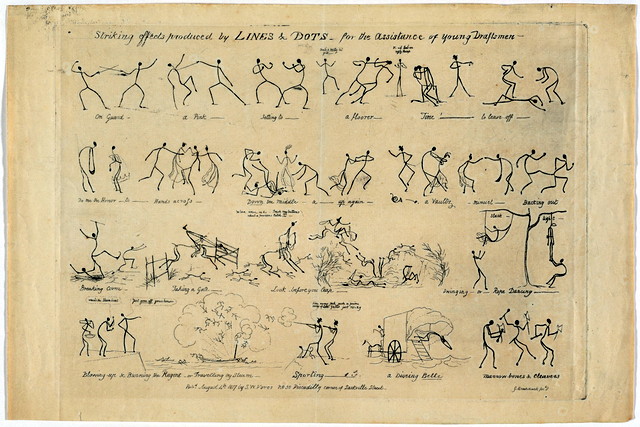
Striking effects produced by lines and dots – Public Domain Collections, New York Public Library.
(For enlargeable images of both prints see also British Museum online collections: Museum No.1862,1217.291 and Museum No.1931,1114.182)
The artwork of the Fores prints is attributed to the caricaturist and illustrator, George Cruikshank, perhaps, now best remembered for his political satires and as an illustrator for Charles Dickens. While their title relates to guide images used to assist young people learning to draw, their intention is clearly comic. The design of individual figures is rather less elegant than in the prints published by Hull, and there is an elaboration of scenes (and, in some cases, even the use of speech bubbles) for humorous affect.
Hull did publish work by Cruikshank,but the differences between the pairs of prints are enough to suggest that they are by different hands. Hull, an artist as well as an engraver of other people’s work, may have taken inspiration from the published Cruikshank drawings to create his “own version”.