

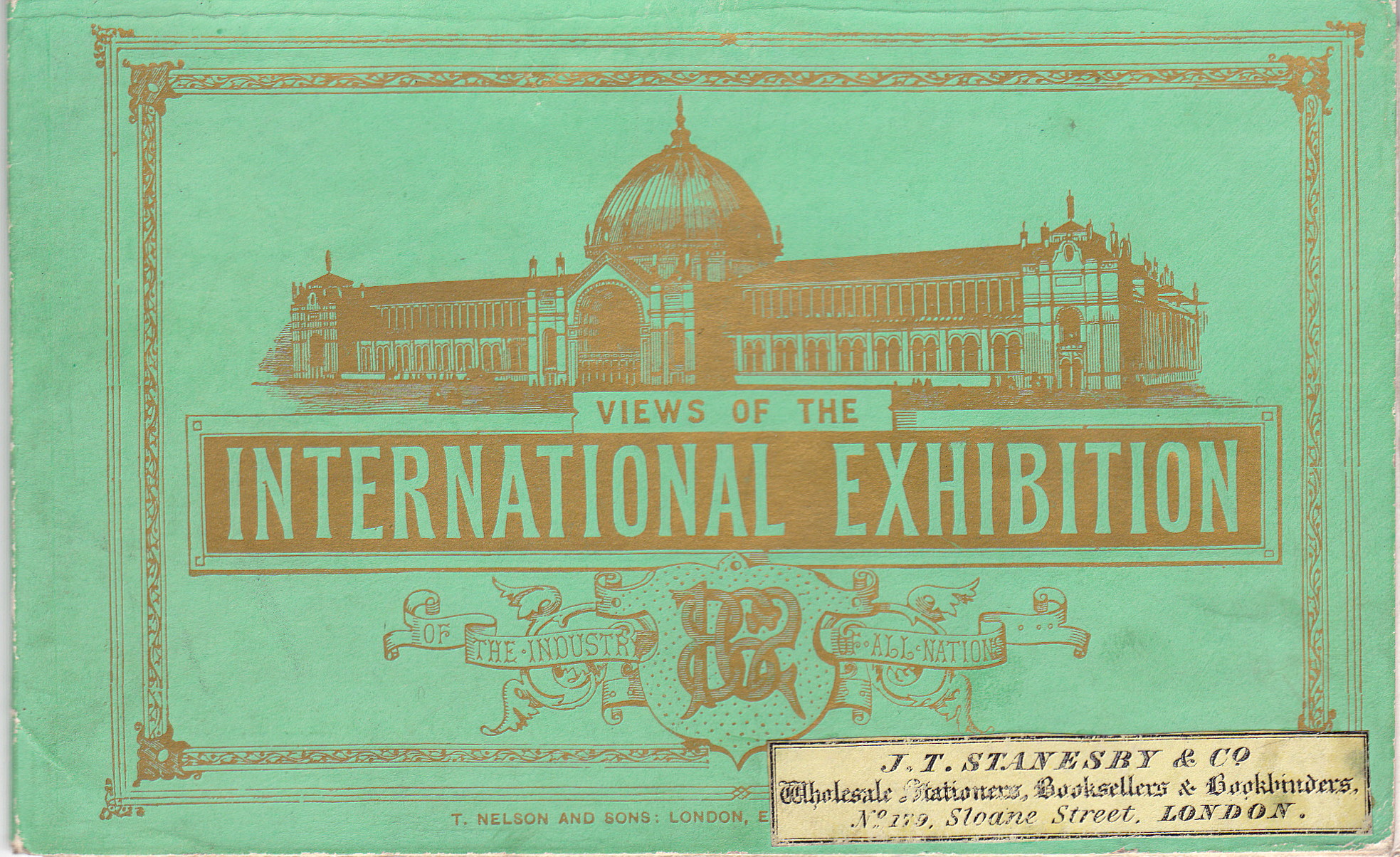
The Great Exhibition of Works of Industry of All Nations took place from May to October of 1851. This Great Exhibition with its venue, the vast iron and glass structure known as the Crystal Palace is a widely familiar icon of Victorian ambitions. Much less familiar are the other exhibitions that followed it in the area of Exhibition Road in London’s South Kensington, now thought of mainly in terms of the major museums and academic institutions that occupy it. Perhaps the most ambitious of these successors was the International Exhibition of Industry and Art held between May and November of 1862. The contemporary souvenir pamphlet whose images and text are reproduced here reveals something of the hopes and expectations involved in this new Great Exhibition.
Descriptive Letterpress
INTERNATIONAL EXHIBITION
GENERAL DESCRIPTION
The buildings erected for the International Exhibition of 1862 have been designed to serve, not merely for that Exhibition, but for all future Exhibitions. They are not at present to be regarded as complete. Enough has been done for the purposes of utility, and much has been left to do in the way of decoration and ornament. If less light and elegant than the first Crystal Palace, they promise to be more solid and permanent, and to require less expense for repair. ” In the realms of architecture,” says a writer in Blackwood, ” the present International Building must be pronounced a hybrid—a transmutation, as it were, of the previously known art-species, according to the true Darwinian laws of natural selection—a compound of the simple-minded agricultural barn, the purely practical and mercantile factory, and the middle-aged cathedral, with nave, transept, and aspiring dome!”
The building is situated to the south of the Horticultural Society’s New Gardens in South Kensington. There is another front on the east, running along the Exhibition Road; and on the west is Prince Albert’s Road. The longest dimensions of the site, that is, from east to west, runs parallel with the Cromwell Road for 1152 feet; from north to south the diameter is 692 feet 6 inches. These measurements are exclusive of the ” Annexe,” devoted to the machinery, the area of which is 872 feet by 200 feet, going directly north and south, at a right angle to the main building. The main features of the building consist in a nave and two transepts, each point of intersection, at the extremities of the nave, being marked by a large hall surmounted by a dome. The nave and transepts are 100 feet high and 85 feet wide; the nave is 800 feet long; and the transepts each 635 feet, including the domes. They arc lighted on both sides by clerestory windows upwards of 25 feet high. The domes, which are 160 feet in diameter and 250 feet high, are the largest of ancient or modern times. The vista from dome to dome through the nave is 1070 feet. At 25 feet from the ground, a gallery runs along each side of the nave and transepts. There is more than a mile and a half of upper galleries, some 50, some 25 feet wide. There are two central glass courts—that at the north 150 feet by 86, the south 150 feet by 150 feet; two other courts, each 250 feet by 86 feet; and two courts, 250 feet by 200 feet. All these glass courts are 50 feet high, and lighted from above. These courts will be the only portions which at all resemble the Crystal Palace—the rest of the building being constructed of brick. The refreshment-hall and arcades overlook the Horticultural Gardens, and will be cool with a sunny view. The machinery galleries extend along the west side of the Horticultural Gardens for 1000 feet in length to 200 feet in width, in 4 spans of 50 feet wide each.
” As a triumph over constructional difficulties,” says the writer formerly quoted, ” as a monument of industrial and mechanical resources, of an epoch signal in scientific appliance, this International edifice is certainly sufficiently marvellous. For mere cubic contents, few works, indeed, either in ancient or modern times, can compare with the present structure. The space of ground tented over is upwards of 20 acres—an area vaster by one-fifth than the square of Lincoln’s Inn or the base of the great pyramid. The length of the nave is 800 feet, nearly one-quarter longer than the nave of St. Peter’s, and is lighted by clerestory windows. The domes, 160 feet in diameter, are wider than those of the Pantheon, the Baths of Caracalla, the Duomo at Florence, the Cathedrals of St. Peter’s and St. Paul’s. Their material and structure, too, are novel and remarkable. We have had iron bridges, and, more recently, iron-clad Warrior steam-frigates ; and now, here is a novel application of the same material employed in this gigantic edifice, which is, like other items, somewhat startling. We are informed that in this giant structure are 10 millions of bricks, 1000 iron columns, one mile of clerestory windows, 17,000 loads of timber, 45,000 superficial feet of glass, and 4000 tons of iron.”
There are 166 round columns for the nave and transepts, 12 inches in diameter, connected with a like number of square pilasters; 312 eight-inch round columns, and 149 twelve-inch square columns for the galleries; 138 eight-inch square clerestory columns ; 160 ten-inch square columns supporting the floors of the picture galleries ; 62 round ones for supporting the roofs of the glass courts. Put all the columns end to end, and they would extend from the Exhibition either eastward as far as London Docks, westward as far as Kew, northward as far as Hampstead, southward as far as Sydenham Crystal Palace.
These immense buildings provide on a large scale for four objects : 1. Picture Galleries, which require to be solid structures, secure from all accidents of weather, extremely well ventilated, and lighted at the top ; 2. Ample spaces of different forms, lighted in different ways, for the Exhibition of Works of Industry, arranged in courts and galleries ; 3. Platforms and wide passages for ceremonials and processions; and, 4. Accommodation for refreshments.
The articles to be exhibited will be divided into the following classes:—
SECTION I.
1.Mining, quarrying, metallurgy, and mineral products.
2.Chemical substances and products and pharmaceutical processes.
3.Substances used for food, including wines.
4.Animal and vegetable substances used in manufactures.
SECTION II.
5.Railway plant, including locomotive engines and carriages.
6.Carriages not connected with rail or tram roads.
7.Manufacturing machines and tools.
8.Machinery in general.
9.Agricultural and horticultural tools and implements.
10.Civil engineering, architectural, and building contrivances.
11.Military engineering, armour and accoutrements, ordnance and small arms.
12.Naval architecture, ships’ tackle.
13.Philosophical instruments, and processes depending upontheir use.
14.Photographic apparatus and photography.
15.Horological instruments.
16.Musical instruments.
17.Surgical instruments and appliances.
SECTION III.
18.Cotton.
19.Flax and Hemp.
20.Silk and velvet.
21.Woollen and worsted, including mixed fabrics generally.
22.Carpets.
23.Woven, spun, felted, and laid fabrics, when shown as specimens of printing or dyeing.
24.Tapestry, lace, and embroidery.
25.Skins, fur, feathers, and hair.
26.Leather, including saddlery and harness.
27.Articles of clothing.
28.Paper, stationery, printing, and bookbinding.
29.Educational works and appliances.
30.Furniture and upholstery, including paper-hangings and paper-mache.
31.Iron and general hardware.
32.Steel and cutlery.
33.Works in precious metals and their imitations, and jewellery.
34.Glass.
35.Pottery.
36.Manufactures not included in previous classes.
37.Architecture.
38.Paintings in oil and water-colours and drawings.
39.Sculpture, models, die-sinking, and intaglios.
40.Etchings and engravings.
Immense quantities of all these things have been sent not only from the countries of Europe, but contributions have been daily arriving from the most distant parts of the world. The show of foreign goods from remote countries will be something quite unprecedented. China and Japan will be splendidly represented in all the varied branches of art manufacture. The Japanese also send an encyclopaedia, illuminated works of natural history and chemistry, a quadrant and sun-dial, a compass, a pedometer, a thermometer, and a telescope. The Chinese send porcelain, carvings, metal works, medical drugs, types, and rare ornaments. Central Africa is represented by raw produce and native manufacture. Western Africa contributes strong cotton cloths, grass cloths, and fine cloth from the palm fibre. Madagascar sends over cloths and native manufacture ; and King Radama II. presents to the Commissioners a chair of native iron. Canada, New Brunswick, Nova Scotia, Vancouver’s Island, Jamaica,—all send specimens of their productions. From all parts of Australia fine collections are arriving. Queensland, amongst other things, sends arrow-root, pine-apples, sandal-wood, wool, black marble, raw silk, gold, sugar-cane, ginger, and many specimens of the best sea island cotton. From Western Australia, Tasmania, Victoria, and New South Wales, the collections are equally good and extensive.
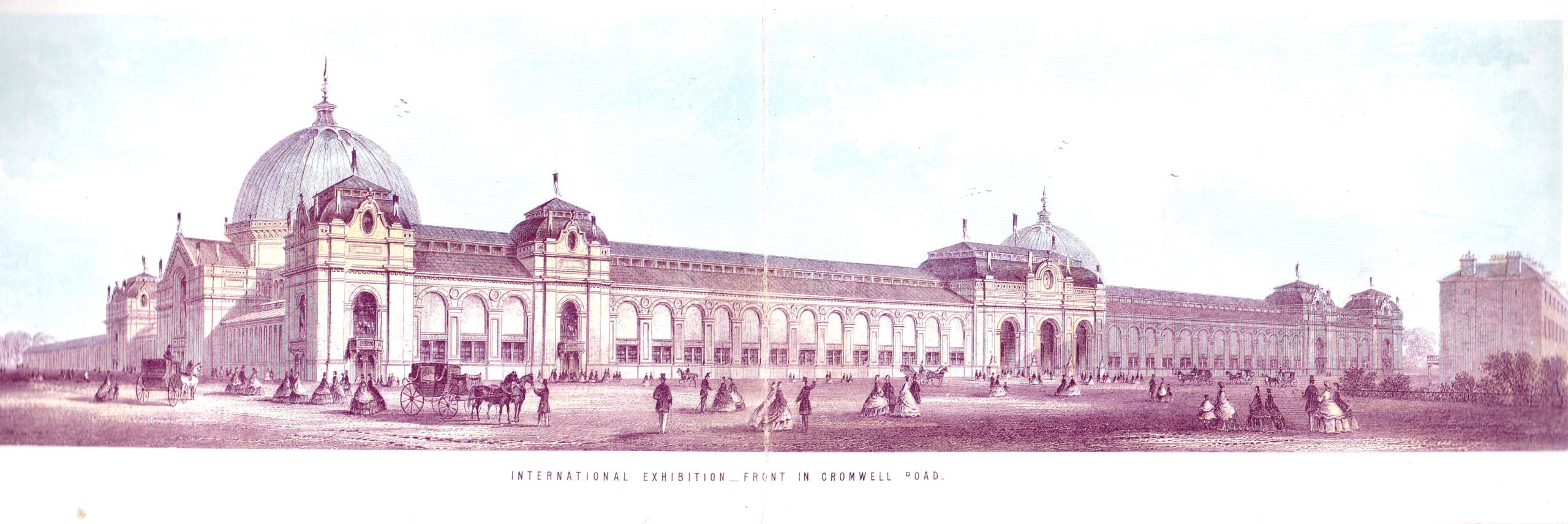
1.—FRONT OF THE PICTURE GALLERIES IN CROMWELL ROAD.
This view shows the main front of the building, running due cast and west, facing the Cromwell Road, and measuring 1152 feet in length. It is divided into two sections by feet wide, which leads to the industrial halls and galleries; whilst two flights of steps, 20 feet wide, lead on either side to the Picture Galleries. The first compartment of the front of the building seen in this view is occupied by the Picture Gallery. It is 1150 feet long, 80 feet wide, and 50 feet high above the ground floor. It is intended to receive the largest size oil paintings and cartoons. The smaller picture galleries are in Prince Albert’s and Exhibition Roads; they are 25 feet wide and 30 high, and jointly 1200 feet long.
” In this country pictures are now for the first time brought within the range of international competition, though in France the experiment is not untried; as, in the last Exposition Universelle in France, 5128 pictures were congregated, and 25 nations represented.”
” This great experiment, made for the first time in Paris, will now be put to a second trial in London, with this difference,—in 1855, the competition was among the living only; in 1862, the illustrious dead are also summoned. One hundred years has been fixed by the English school as its historic limit,—thus appropriately including and dating from Hogarth. Other countries have, in like manner, determined the point of departure according to the several exigencies in their national art. Thus, in the present year, will it be made possible, not only to determine present results, but to trace back anterior causes; thus the contest will not only extend over vast territories of geographic space, but will reach across fields of bygone time,—climate, and race, and epoch, each giving a specific character: the landscape of the northern fiord rugged and grand, the sky of the south sunny and serene; some peoples prosaic, hardy, and self-restrained, others sensitive, imaginative, and luxurious ; some eras simple, virtuous, and severe, other periods sumptuous, vicious, and supine;- these are the influences brought into competition; such the elements which must be carefully calculated in our ultimate estimate of the world’s congregate .arts.”
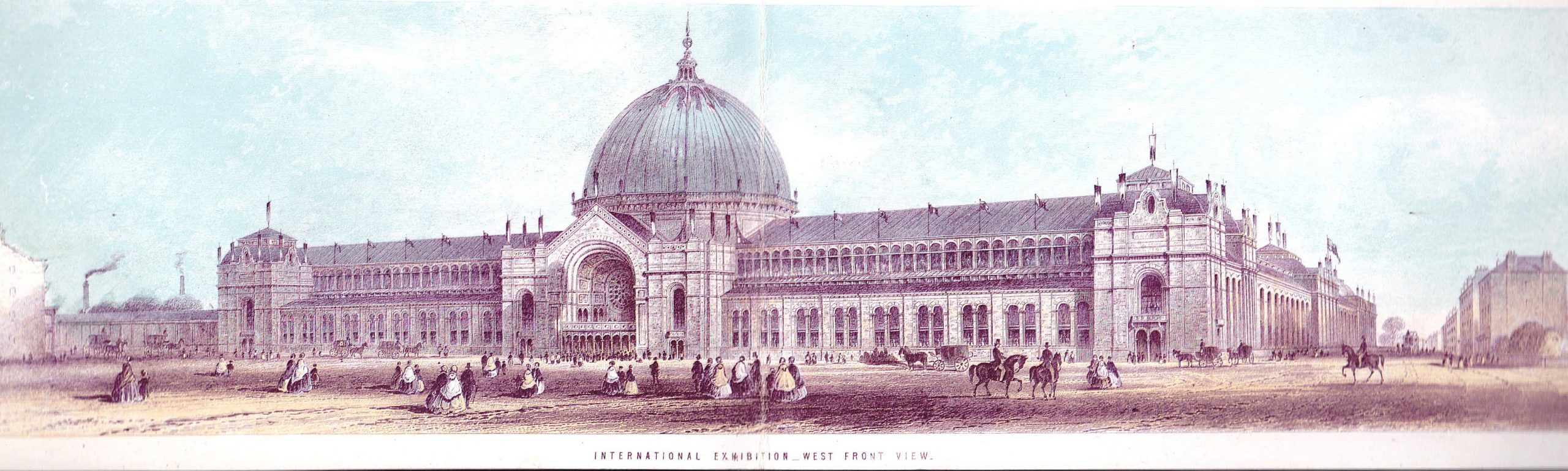
2.—FRONT OF THE BUILDING FOR WORKS OF INDUSTRY IN PRINCE ALBERT’S ROAD.
The entrances to the industrial buildings are in Prince Albert’s and the Exhibition Roads, Each of these fronts presents a lofty facade, similar in general design to the south, from the centre of which rises a superb dome of glass and iron. These magnificent domes are of unrivalled size and beauty. The interior decoration is very fine. The inscriptions in white letters on a rich blue ground round the belt of the western and eastern domes are very appropriate. Both are taken from the 1st Book of Chronicles, ” O Lord, both riches and honour come of thee, and thou reignest over all; and in thine hand is power and might, and in thine hand is to make great;” while round the west is painted, ” Thine, O Lord, is the greatness, and the power, and the glory, and the victory, and the majesty; for all that is in the heaven and the earth is thine; thine is the kingdom, O Lord, and thou art exalted as head above all.” On the walls terminating each transept also, similar appropriate sentences are inscribed.
The main entrance beneath the dome (see View), is 60 feet high by 50 feet wide, with two smaller porches at either side 40 feet by 15 feet.
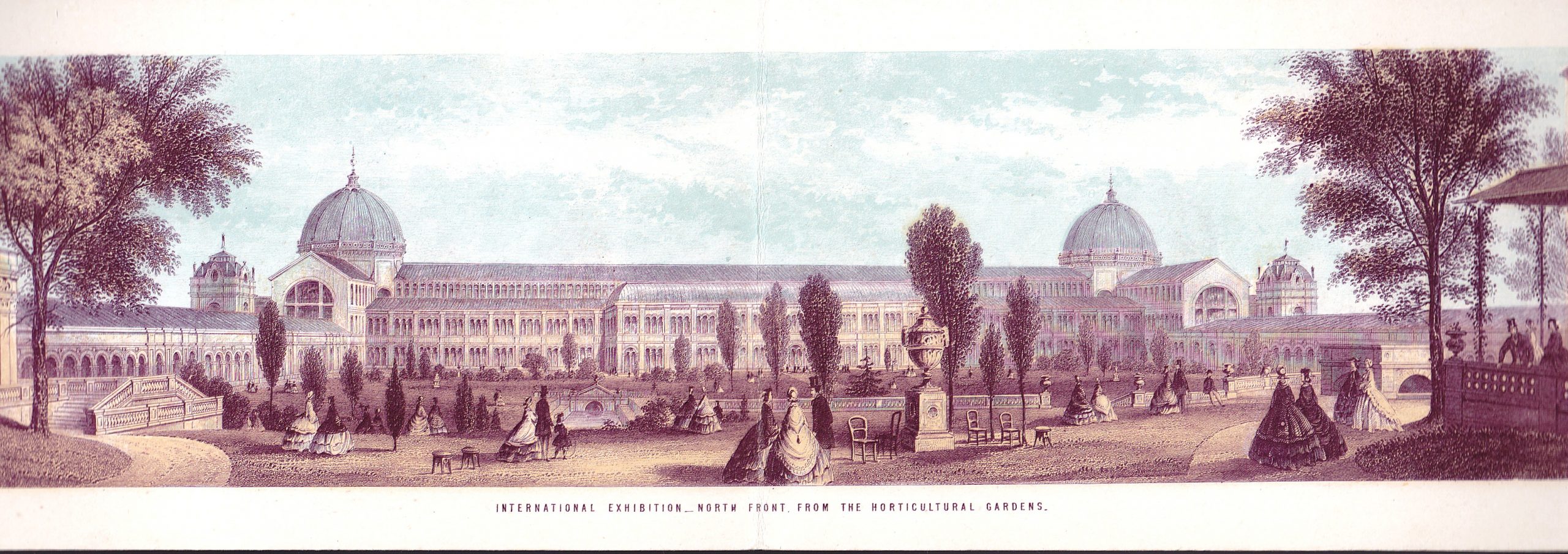
3.-VIEW OF THE NORTH FRONT FROM THE GARDENS OF THE ROYAL
HORTICULTURAL SOCIETY.
This view shows the north front of the building, along which run the halls and arcades for refreshment rooms. The halls will be 300 feet long by 75 feet wide. The two arcades will be about 1500 feet in length, and 25 feet in width.
The machinery galleries run along the west side of the Horticultural Gardens. The grounds are beautifully laid out, and will be an attractive promenade during the time of the Exhibition.
Five noblemen and gentlemen have been appointed under the ” Patent of Incorporation,” to take the entire direction of! the Exhibition of 1862 as Her Majesty’s Commissioners. The building has been erected after the design of Captain Fowke, R.E., to whom all proceedings are submitted. The contractors are Messrs. Kelk and Lucas, for whom Mr. Meeson, C.E., prepares the working drawings.
While thus giving a list of those who are managing this great undertaking, it is impossible to forget that the first design of it was the conception of the Prince for whom the nation now mourns, and whose death will cast a gloom over the opening of that great edifice, which owes its existence to him.
” The nations are invited to a jubilee, but they will find the land in mourning. Imperial robes are turned to sack-cloth, and she who bears the sceptre is bowed in sorrow. The congress of princes and peoples will want its chief. The head which directed in wisdom is now laid low. But great thoughts perish not, grand ideas live on as the heritage to survivors.
“The Prince whose loss we mourn, and whose memory we cherish, devoted no small portion of his life to the service of those arts which the Exhibition is designed to illustrate. His sagacious mind seized upon art, indeed, as an appointed means and an efficient agency to a people’s exalted culture. Science he loved as the daughter of nature and a helpmate to man ; and hence he sought, with a diligence that never wearied, with a knowledge that had scarcely its equal, to secure for the country of his adoption those high benefits to which science, art, and allied industry are ever found to minister. Be it our privilege and abiding duty to accomplish the ends for which he nobly lived. The International Exhibition was his fond design—Si monumentum requiris, circumspice.”
The mourning referred to at the end of the pamphlet relates to Albert, the Prince Consort, husband of Queen Victoria, who had been deeply involved in the promotion of the Great Exhibition, and a supporter of arts science and industry more generally. He had died of typhoid fever in December of 1861. Si monumentum requiris, circumspice, “If you require a monument, look around you” relates to an inscription in St. Paul’s Cathedral concerning its architect, Sir Christopher Wren, Prince Albert being represented as having a similarly creative role for the 1862 exhibition.
Despite this publication’s claims about the monumental qualities the building illustrated, and the suggestion that it would serve “for all future exhibitions” it was, in fact, demolished by the end of 1864, some of its materials being
taken for the construction of another great centre of exhibition and entertainment, Alexandra Palace, in north London. The story of the convoluted economics and politics of this decision can be found in the Survey of London (“The
Exhibition Building of 1862”. Survey of London: Volume 38, South Kensington Museums Area. Ed. F H W Sheppard (London,1975) British History Online. Web. 8 September 2025. (
https://www.british-history.ac.uk/survey-london/vol38/pp137-14). The site would provide a home for the Natural History Museum, which still stands there.
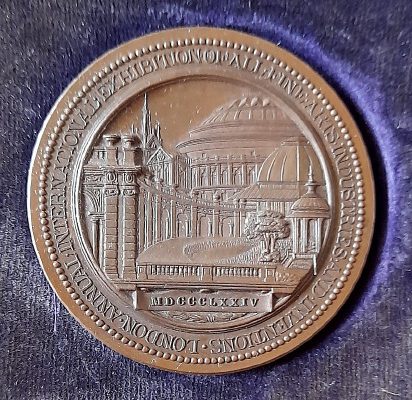
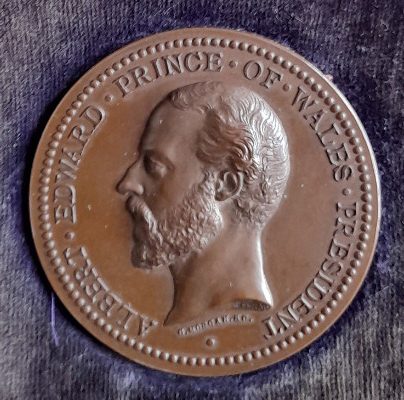
Nonetheless, the South Kensington area would go on to host other international exhibitions in the course of the 19 th century. These included theAnnual International Exhibitions held between 1871 and 1874 (initially intended to be carried on over a longer period). These were held in buildings a little further north, around what were then the Royal Horticultural Society Gardens. On the exhibition medal for 1874, shown below the dome of the Royal Albert Hall is visible. Though now thought of almost exclusively as a concert venue, the Hall was used as part of the exhibition space.
For further details of the 1862 Exhibition and its predecessors see:
The International Exhibition of 1862 : the illustrated catalogue of the Industrial Department, Vol.1
https://archive.org/details/internationalexh01lond
The Record of the International Exhibition, 1862
https://archive.org/details/recordofinternat00lond
Remembrances of the Great Exhibition, 1862
https://archive.org/details/remembrancesofgr00unse